NVIDIA DLSS 5: The ‘GPT Moment for Graphics’ Arrives This Fall
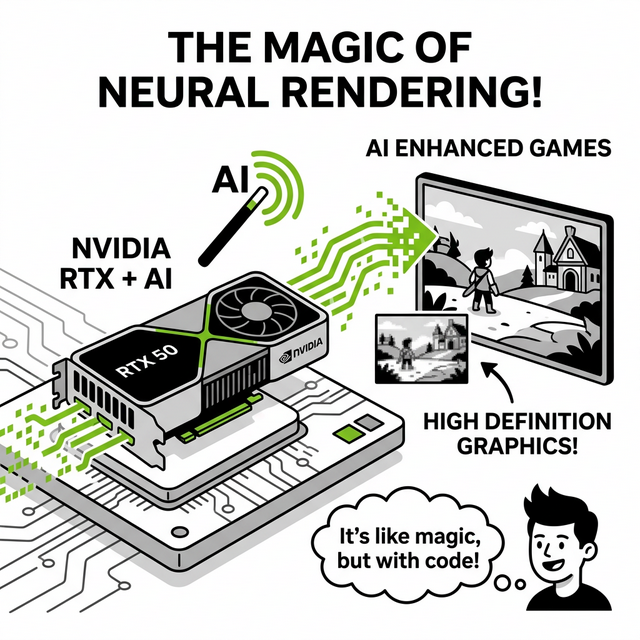
NVIDIA has announced DLSS 5 during its GTC 2026 conference, describing the new technology as the “GPT moment for graphics” — a reference to the transformative impact that language models had on AI. The company claims this is its most significant breakthrough in computer graphics since the debut of real-time ray tracing in 2018.
Context
Twenty-five years after inventing the programmable shader, NVIDIA is reinventing computer graphics once again. DLSS (Deep Learning Super Sampling) was originally launched in 2018 as an upscaling technology that rendered games at lower resolution and used AI to upscale to native resolution.
The technology has evolved significantly over the years:
- DLSS 1.0/2.0: Resolution upscaling using AI
- DLSS 3: Frame Generation — generating entire frames
- DLSS 4.5: Drawing 23 out of every 24 pixels on screen
- DLSS 5: Neural Rendering — transforming visual fidelity
Jensen Huang, founder and CEO of NVIDIA, stated that DLSS 5 “blends handcrafted rendering with generative AI to deliver a dramatic leap in visual realism while preserving the control artists need for creative expression.”
Details
What is Neural Rendering
DLSS 5 introduces a real-time neural rendering model that infuses pixels with photorealistic lighting and materials. Unlike previous versions focused on performance, DLSS 5 is a visual pipeline update that transforms the visual fidelity of games.
The technology works as follows:
- Takes color and motion vector data from each game frame
- Uses an AI model to infuse the scene with photoreal lighting and materials
- Keeps output anchored to the original 3D content
- Runs in real-time at up to 4K resolution
Model Capabilities
The AI model is trained end-to-end to understand complex scene semantics:
- Visual elements: characters, hair, fabric, translucent skin
- Lighting conditions: front-lit, back-lit, overcast
- Single-frame analysis: understands everything by analyzing just one frame
The result is visually precise images that handle complex elements:
- Subsurface scattering on skin
- Delicate fabric sheen
- Light-material interactions on hair
All while maintaining the structure and semantics of the original scene.
Artist Control
NVIDIA emphasizes that DLSS 5 preserves artistic control. Developers will have detailed controls for:
- Intensity: adjust effect strength
- Color grading: blending, contrast, saturation, gamma
- Masking: exclude specific objects or regions from enhancements
This allows artists to determine where and how enhancements are applied, maintaining each game’s unique aesthetic.
Compatibility and Requirements
DLSS 5 will launch in fall 2026. Compatibility is expected to be limited to RTX 50-series GPUs based on the Blackwell architecture, such as the RTX 5090.
During GTC demos, NVIDIA used two RTX 5090s — one to run the game and another exclusively to run DLSS 5. The company states the technology is designed for single GPU use and will ship that way, though additional optimizations are ongoing.
Confirmed Games
The first wave of DLSS 5 titles includes:
- Starfield (Bethesda)
- Assassin’s Creed Shadows (Ubisoft)
- Hogwarts Legacy
- Resident Evil Requiem (CAPCOM)
- Delta Force
- NARAKA: BLADEPOINT
- The Elder Scrolls IV: Oblivion Remastered
- AION 2
- Sea of Remnants
- Where Winds Meet
- Phantom Blade Zero
- CINDER CITY
- Black State
- Justice
- NTE: Neverness to Everness
Industry Support
Major studios and publishers have already shown support for the technology:
Todd Howard, studio head at Bethesda: “When NVIDIA showed us DLSS 5 and we got it running in Starfield, it was amazing how it brought it to life. We’ve played it. We can’t wait for all of you to do so as well.”
Jun Takeuchi, executive producer at CAPCOM: “DLSS 5 represents another important step in pushing visual fidelity forward, helping players become even more immersed in the world of Resident Evil.”
Charlie Guillemot, co-CEO of Vantage Studios: “The way it renders lighting, materials, and characters changes what we can promise to players. On Assassin’s Creed Shadows, it’s letting us build the kind of worlds we’ve always wanted to.”